Foldable or rigid: pick the channel first, the product second
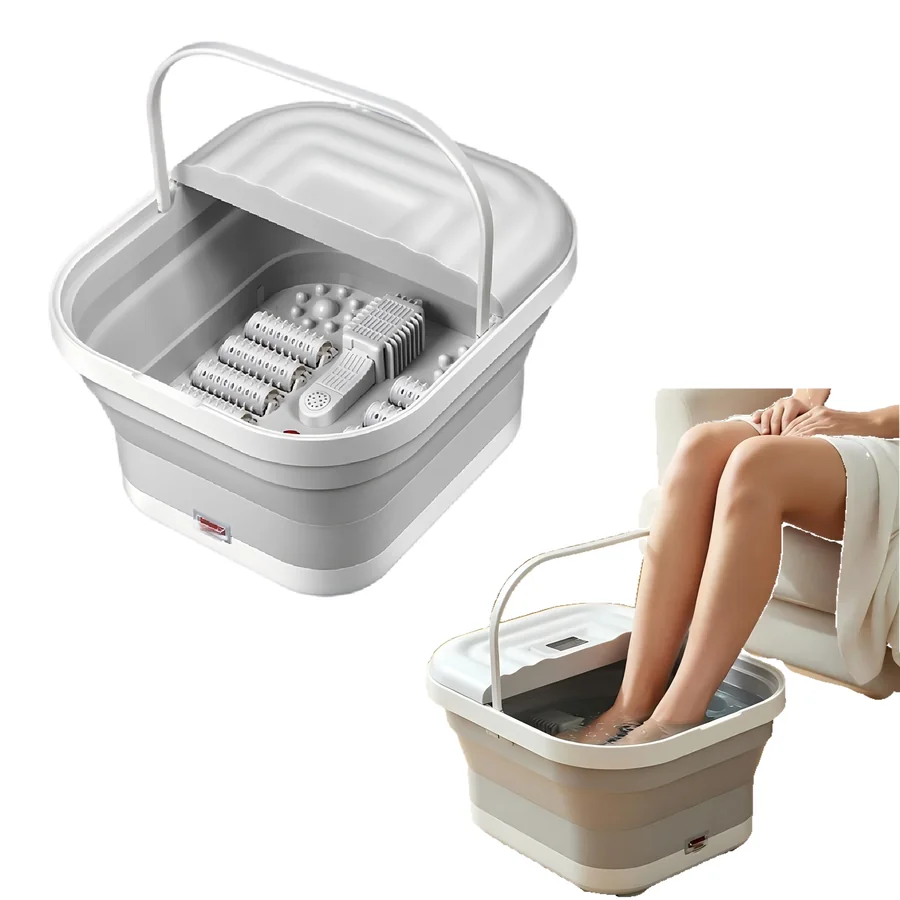
Foot baths look like the simplest product in the catalogue and they generate a disproportionate share of after-sales problems, for two reasons: heating power and the fold.
Both are decided at the specification stage and both are invisible on a product photo. This guide is about choosing the construction before you choose the model.
Why the 110 V version heats so much slower
For a resistive heater, power falls with the square of the voltage. An element rated for 220 V produces roughly a quarter of its power at 110 V. A tub that reaches temperature in fifteen minutes in Europe can take close to an hour in North America, and the customer reads that as a broken product rather than as a physics problem.
The fix is a different heating element and a different control board for the 110 V build. It has to be decided before production, and it means the two market versions are two SKUs, not one SKU with a different plug.
The fold is a seam, and seams leak
| Foldable | Rigid | |
|---|---|---|
| Storage | Collapses to a fraction of the height | Takes up floor space |
| Seam risk | Every fold is a flexing joint in contact with water | One moulded body, fewer joints |
| Channel fit | Small apartments, online retail, gifting | Clinics, repeat use, rental, hospitality |
| Freight | Lower volume, better per-unit freight | Higher volume, pallet heavy |
| Repair | A leaking fold usually ends the product | A leaking valve or hose is replaceable |
Ask how many fold cycles the seam was tested for, whether the liner is a single moulded piece or a bonded joint, and what the warranty covers on a leak. A warranty that excludes leaks on a foldable tub is telling you something about the fold.
The controls are where water gets in
The second ingress point after the fold is the control panel. Ask for the waterproof rating at the panel specifically, not a general splash claim, and ask whether the buttons are membrane or mechanical. Mechanical buttons with a rubber boot last longer in a wet environment than a sealed membrane that cracks at the flex point.
Freight decides the retail price on this category
A foot bath is bulky for its value. On small orders the freight per unit often exceeds the product cost, which means the retail price is set by the carton as much as by the bill of materials. Ask for the carton dimensions, quantity per carton and gross weight before agreeing a price, then ask whether shipping in a plain carton with the retail box packed flat is cheaper overall. On foldable models it frequently is.
Matching the product to the buyer
- Online retail and small apartments — foldable, and the fold is the feature you are selling. Accept a shorter life and price accordingly.
- Clinics, salons and hospitality — rigid, because it runs daily and a leak ends the product. Buy the model with replaceable parts.
- Gifting — foldable wins on shelf presence and on shipping to a residential address.
- Wholesale to a physical store — rigid, because the customer can compare build quality by hand.
What to send us
Market and voltage, the channel you sell into, quantity and destination postcode. We will quote both constructions with carton figures so the delivered cost comparison is real.
Questions we get on this
Can a foldable tub last as long as a rigid one?
What heating power should I specify?
Is a bubble function worth adding?
Do foot baths need special certification?
Nothing is stored on this site. The message opens in your own WhatsApp or mail app, so you can see exactly what you are sending.